

A significant shift in Australia's tax landscape is coming. Now is the time to understand what it could mean for your investments and long-term financial strategy.
The 2026–27 Federal Budget introduced some of the most significant changes to Australia's Capital Gains Tax (CGT) system in more than two decades. For property investors, share investors and business owners, these reforms could have a considerable impact on future investment returns and tax liabilities.
From 1 July 2027, the way capital gains are calculated will change, moving away from the longstanding 50% CGT discount towards a system based on inflation.
While July 2027 may seem some time away, understanding the changes now could help you make more informed financial decisions and avoid unnecessary complications down the track.
What's changing from 1 July 2027?
Under the current system, eligible Australian resident individuals who hold an investment asset for at least 12 months can generally reduce their capital gain by 50% before calculating their tax liability.
The new system will see three key changes:
The removal of the general 50% CGT discount for eligible future gains of individuals, trusts and partnerships, subject to certain exceptions.
The introduction of cost base indexation, which adjusts the cost base of an investment in line with inflation.
A minimum 30% tax rate on certain real capital gains for individual taxpayers, with some exemptions.
Importantly, the minimum 30% tax rate does not mean you will pay 30% of your property's sale price. It relates to the relevant taxable capital gain after applicable adjustments.
Understanding the impact: old rules vs new rules
To understand how the change could affect investors, let's look at a simplified example.
Imagine you purchased an investment property for $600,000 and later sold it for $1 million.
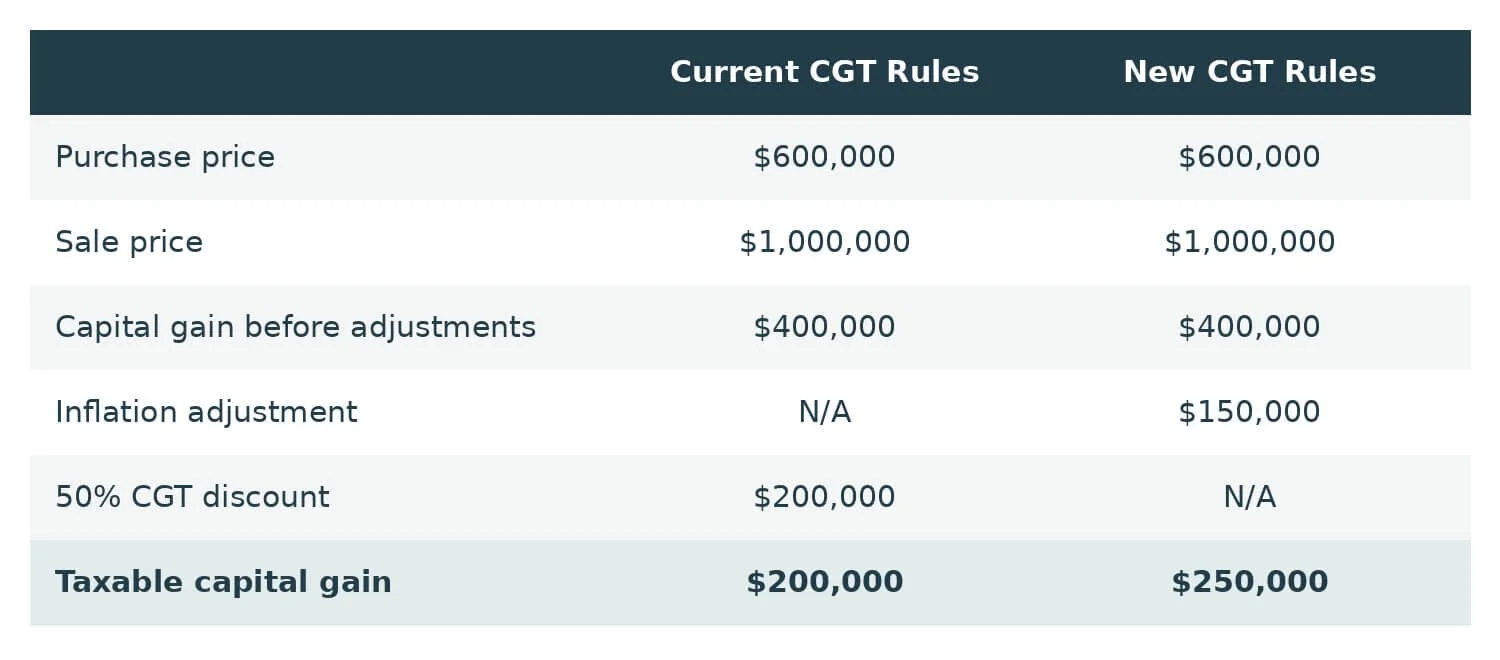
In this example, the amount subject to tax increases by $50,000 under the new system.
However, the outcome will not be the same for everyone. Inflation, asset growth, ownership periods and individual tax circumstances will all influence the final result.
This example is illustrative only, assumes eligibility for the respective concessions and excludes additional cost base adjustments, capital losses and transitional arrangements.
Already own an investment property? Here's what you need to know.
One of the most important aspects of the reforms is that the existing 50% CGT discount will not simply disappear overnight for assets you already own.
Instead, for eligible existing investments sold after the transition date, your capital gain will generally be divided into two periods:
Before 1 July 2027: Eligible capital gains accumulated before the transition date will continue to receive the existing 50% CGT discount.
From 1 July 2027: Capital growth occurring from this date will generally fall under the new inflation-adjusted system and applicable minimum tax provisions.
This distinction is particularly important for long-term property investors who have already accumulated substantial capital growth.
Simply owning an investment on 1 July 2027 will not, in itself, trigger an immediate capital gains tax bill.
Why 1 July 2027 is an important date for property valuations
Knowing the market value of your investment property at the transition point could become an important part of your future tax planning.
Establishing this value will help determine how much of your capital gain is attributable to each tax period.
For many investors, obtaining a professional property valuation may be a sensible step towards supporting future CGT calculations.
The ATO is also developing further guidance, including an alternative apportionment method that may be available to some investors.
While you may not need a valuation immediately, planning ahead and maintaining accurate records could save considerable time and expense when you eventually decide to sell.
Are there exceptions to the new rules?
Not all properties and investors will be affected in the same way.
Your family home: The existing main residence exemption remains unchanged, subject to the usual eligibility requirements.
Eligible new builds: Investors may be able to choose between the existing 50% CGT discount and the new inflation-adjusted system.
Income support recipients: Certain recipients, including eligible pensioners, will be exempt from the minimum 30% tax.
Pre-1985 assets: Assets previously exempt from CGT may become subject to tax on gains accumulated from July 2027.
Understanding which rules apply to your individual circumstances will be essential.
Should you consider selling before July 2027?
Understandably, some investors may be wondering whether now is the right time to sell.
However, making a significant financial decision based purely on a change in tax legislation is not necessarily the best approach.
Your investment strategy should also take into account rental returns, future capital growth, borrowing costs, retirement plans and your broader financial objectives.
For some investors, selling before the changes take effect may be worth exploring. For others, retaining their investments may remain the better long-term strategy.
The key is understanding the numbers before making a decision.
Five things investors can do now
Rather than waiting until July 2027, there are several practical steps you can take to prepare:
Review your investment portfolio and identify which assets may be affected by the changes.
Organise your financial records, including purchase documents, renovation expenses, depreciation schedules and other relevant ownership costs.
Discuss property valuation requirements with your accountant ahead of the transition date.
Review your long-term investment and retirement strategy, particularly if you are planning to sell assets in the coming years.
Seek professional tax advice before making significant investment decisions or changes to your ownership structure.
Looking ahead with confidence
Tax legislation changes, but the importance of good financial planning remains the same.
The upcoming CGT reforms are a timely reminder that building wealth is not just about the investments you make, but also about how you manage, structure and eventually realise those investments.
At Innovate Services, we encourage our clients to take a proactive approach to their financial and tax planning. Understanding how these changes may affect you today can help you make more confident decisions tomorrow.
If you own an investment property, hold other investment assets or are considering selling in the coming years, now is a great time to start the conversation.
Get in touch with the Innovate Services team to discuss what the upcoming CGT changes could mean for you.
This article is general in nature and reflects information available as at November 2026. Further legislative details and ATO guidance may be released. We recommend seeking professional advice based on your individual circumstances.
SOURCES & INTERESTING READS:
Duo Tax — Federal Budget 2026: What Property Investors Need to Know
Australian Taxation Office — Capital Gains Tax Reform
Australian Treasury — Budget 2026–27 Tax System Changes